Showing posts with label bacteria. Show all posts

Friday, 8 July 2011

fermented compost - diy style

In the last post, we took a quick look at worm nests, what they are and how they are a critical function of the fermented compost method.  As promised at the foot of that post, this time we're going to look at how to get your own DIY fermented compost system together.

I'll state here that fermented compost is more or less the same as Bokashi Kitchen Composting.  I say more or less, because there are a few minor differences - Bokashi is a proprietary system, developed in Japan, which utilizes a specially designed Bokashi composting bucket, which you can see here:

bokashi kitchen composting caddy

you'll note it has a tapering design, with a lid on top and a tap underneath, from which you collect the juice from the decomposing food waste placed inside.  Inside the Bokashi bucket, you have a filter and it comes with a scoop and a plastic "tamper" for squishing down the food waste:

inside the bokashi kitchen caddy

Bokashi is a Japanese word, meaning "fermented organic matter" and is a system of trench composting method used on "ultra organic" farms, as part of the Kyusei Nature Farming movement - monks who believe in using permaculture based farming practices as a spiritual path to connect with nature's rhythms.  In the original Bokashi system, rice bran is fermented with microbes, is dried out, then mixed with vegetable waste, animal manure and liquid microbe brews and then layered up in the trench, to convert to humus under the soil.  It's similar in many ways to Rudolf Steiner's various preparations, familiar to those who practice Bio-Dynamic Farming.

classic bokashi making
In the 1990's Dr Higa of Ryukyus Univeristy in Okinawa decided to make his own commercial microbe brew and wanted to adapt the Bokashi system for the kitchen - to encourage urban dwellers to engage in this organic system for building healthy, humic soil and so the Bokashi Kitchen Composting system was born. All well and good, but there are a few flaws in the system which can mean the difference between well made and healthy fermented compost and a black, sloppy and potentially pathogenic problem. It seems not all the stages of making fermented compost have translated too well, so here we go back to basics and we look at a DIY method, without the need to buy in to the commercial system.

First, you have to understand that the key to making the best kind of fermented compost is to make sure the system is air-tight, being an anaerobic (without air) process.  Like a stomach, we need to make a chamber which keeps out air, to allow the anaerobic microbes to ferment the food waste, but which allows any liquid to percolate through the microbe-rich bran (we use wheat bran, not rice bran) and collect separately.

For this, we need two empty and air-tight containers, one to fit snugly inside the other, like this:

one fits snug inside the other - an airtight seal

You can see that when they're placed one inside the other, there's a gap at the bottom, between the two containers.  This is where the juice will collect.  In this pic, i'm using two popcorn buckets for demonstration only - you won't fit much food waste in a bucket this size.  If you don't generate much food waste something this size will do you fine, but for a larger family, a larger twin bucket system will be needed, though the principle stays the same:

how it all fits together

This is the bucket system we made and you can see there's already some food waste in the top bucket and some juice collecting in the gap, as previously described.  So how does the juice get into the gap? Well, for that, you need to either drill holes in the base of the top bucket/container, or use a heated metal skewer (usual health and safety caveats apply here - in short, use some common sense):

drilling holes in the top bucket

Once your kitchen bucket system is ready, you need some microbe-laden bran, or BUGS bran as i call my own bran which i make for our family and friends.  Speak to your local council for a supply, check out ebay for Bokashi Bran, but be aware - some commercial producers of the bran don't put much in the way of microbes in the bran they sell and that can mean little to no fermentation takes place, which can mean problems arise.  The bran you get should smell strongly of salt and vinegar crisps, crossed with wheatabix - if it doesn't, it's likely that the bran producer is skimping on the supply of microbes to the mix.

Phase 1

Once you have your container/bin, sprinkle a layer of BUGS bran over the bottom. Don’t worry if some bran falls through the holes to the lower container.

Layer up all food waste.  This can be cooked or uncooked food, diary, citrus, bread, meats, teabags, coffee grinds, etc.  Remember to chop larger items, e.g. cauliflower stems, banana skins. A pair of scissors is a handy tool for this:

chopping waste to create a better fermentation action


Push the food waste down firmly to allow any liquid to drip through the holes in the bottom.  We recommend using a potato masher.  The objective is to push any air out of the waste and force excess liquid through the holes to the bottom gap:

mashing down = no air gaps


Sprinkle over BUGS bran to cover the surface of the waste and seal the container:

covering with BUGS bran


Repeat layering food and bran until the container is full.  Don’t forget to get as much air out as possibly by applying firm pressure.  You should keep your bucket assembly in the kitchen, where it's most convenient to get to:

stores tidily away


Phase 2

Once the container is full, it will need to be left to ferment for a minimum of two weeks.  But before storage, the liquid must be removed.  Lift out the inner container and pour the liquid into you compost bin or down the drain.  Putting this down the drain in summer can help keep your drains unblocked.

draining the liquid


During the process of compiling the waste the liquid from the decaying food will percolate through the bran, waking up the dormant microbes, which will begin to ferment the food waste. A layer of brown liquid will have collected in the gap between the containers.  On top of the liquid you may see white lumps floating – this is a product of the casein forming bacteria, which indicates the fermentation process is underway.

products of good fermentation


Once you've drained off the liquid from the bottom container, put the assembly back together and store out of direct sunlight for two to three weeks minimum to allow full fermentation.


storing outside to ferment

Whilst the full bucket assembly is fermenting for two weeks, you'll need another assembly of two buckets, prepared in the same way, to continue to collect your kitchen food waste.  Instead, you can do what we do and transfer the contents of your food waste into a larger sealable container, which you can then store for longer:
transferring to a larger container

As you can see, I have three larger containers, all full with fermented compost.  these larger containers I managed to blag obtain from a local company, who were throwing them out.  The benefit of transferring to a larger container is that you can store the fermented compost for months until you want to move on to the next stage.

If you've transferred your fermented waste to a larger container, you'll now need to wash out your kitchen bucket assembly with fresh tap water- I simply use a garden hose (and no soaps or detergents).

washing out your bucket system

and then add a layer of bran over the holes in the (cleaned) top bucket again, ready to go back in the kitchen:

getting ready to go again


Phase 3


After the fermentation phase is complete, dig a trench approximately 10” – 18” deep and spread the fermented compost across the base of this trench. 

digging a trench for your fermented compost

The compost will still look as it did when first added to the process, albeit slightly browner. Backfill the trench with soil and you're done! (remember to clean down your buckets of course - see above)

back-filling with topsoil


Leave in the ground for 8 – 13 weeks (depending on soil temperature / time of year).

Halfway through the 8 week in-soil phase, feel free to get a spade and go investigate - you should now see your very own worm nests!

worm nest!


Once the compost has been in the ground for the minimum required time, dig over the soil where the compost was buried and see the soil quality for yourself.

Over time, the soil will build into a rich, humic and highly nutritious growing medium - able to retain moisture, feed plants luxuriously and become a home to many healthy earthworms. 

Tuesday, 5 July 2011

microbes in the community

"summer's here and the time is right, for..." ...dancing in the streets 

attending garden parties and hearing all about microbes?

Ok, so that may never take off as a remake of the famous Motown hit, but nonetheless, this weekend saw a raft of garden parties, fêtes, school fayres and the like, full of festive folks enjoying the wonderful English summer, whilst supporting local good causes.

On Saturday and Sunday, the sun was shining brightly, the summer breeze was wafting gently and the stall at our local Old Town Festival event was well attended, with visitors eager to see what BUGS was all about, smell the difference between the untreated bran and the microbe-rich BUGS bran (which most people agreed smells like really strong salt and vinegar crisps, crossed with wheatabix!). The pictures of worm nests drew particular interest, yet although most people claimed to be squeamish, not one turned the page to avoid the close-up pictures but instead bent forward, looked more closely and asked all sorts of intelligent and interesting questions about what it was they were looking at. (more to follow on that subject, over the next few blog posts, given it proved so popular)


We gave away samples of microbe brews, for those interested to try for themselves, we spoke about peak oil and what this would mean for food growing in the future (if we can't afford the rising cost of synthetic Nitrogen, how exactly are we going to feed ourselves?) as well as the even more troubling concept of peak phosphor, given that whilst Nitrogen at least can be synthesized, phosphor can't be.

All in all, visitors to the stall were interested, engaged and wanted to know more, even though not all those attending grew organically. Hopefully we gave those we saw something new to think about and encouraged some to think about what they might do to start growing food for themselves, organically (and with the help of beneficial microbes).

At various points during the afternoon, those attending the garden fête gathered around to hear a variety of speakers give presentations, which the organisers had arranged. Nobody had expected a talk all about "the fascinating world of micro-organisms" but there it was - like a living example of the nerd in the yakult advert (you know the one - that poor nerdy chap who talks endlessly about bacteria and who pretty girls avoid at all the hippest parties) waxing lyrical about the role of beneficial microbes and what they can do for plant and human well-being.

Contrary to expectations, the talk went down rather well (who'd have thunk!) with many listeners making a bee-line for the stall to learn more and see what it was all about in greater detail.  One illustrative graphic was employed, showing the scale of the microbial world under discussion.  In fact, the graphic (see below) set the scene in describing the otherwise hidden world, bringing it to the light of day and into the focus of attention.

So when otherwise trivial facts emerged from the talk, such as the fact that, in a typical teaspoon of garden soil, there are approximately 5,000,000 bacteria - it became a figure not entirely meaningless, but an illustration of just how diverse and biologically active this hidden world beneath our feet really is.

Other fascinating facts, such as the mind-boggling statement that over 90% of the cells in our bodies are actually bacteria, carried real weight. Here in this blog (and in the "about this blog" page), we've referred to the fact that as a society we've been conditioned to think of bacteria as products purely of disease, of illness and of harm.  Now, taking the above graphic into consideration and coupled with that 90% bacteria by volume factoid, do you still think it's all about disease?  Hopefully not... and hopefully the door is opening on seeing bacteria as a natural part of who we are and what we are, as creatures who are partners to an invisible army of allies.

The soil food web is a subject we've yet to cover in depth in this blog, but as is the case with the above 90% of our bodily system factoid, so is the case within the soil - bacteria (and other microbes) form the foundation for an entire mini-ecosystem of partnership, of beneficial biological action that unbeknown to us humans at our scale, nevertheless benefits us in ways we simply can't perceive - or at least not without the help of tools such as powerful microscopes.

So, in summary, the sun shone, the breeze wafted gently and in one small corner of traditional English culture, science, tea and home-made cakes mixed to create an eclectic diversion for those in attendance.

Wednesday, 29 June 2011

the fascinating world of bacteria

here's Bonnie Bassler's take on the subject of bacteria:


in the last post, we saw how to make a compost tea (the 24 hour recipe) which is essentially a way of moving bacteria and other microbes from the contents of the compost pile into a liquid that can be applied to our precious plants.

but is that the only method of improving the bacterial content of our soils?  compost teas is but one route to take, as caretaker of the organic realm:


Compost Teas vs. Compost Extracts

First, it may be helpful to share some common terminology and practices associated with compost teas. How do compost teas differ from compost extracts or compost leachates?

Compost Leachate

Compost windrow leachate—the dark-colored solution that leaches out of the bottom of the compost pile—most likely will be rich in soluble nutrients; but, in the early stage of composting it may also contain pathogens. It would be viewed as a pollution source if allowed to run off-site. Compost leachate needs further bioremediation and is not suitable or recommended as a foliar spray.

Compost Extract

Compost watery extract—made from compost suspended in a barrel of water for 7 to 14 days, usually soaking in a burlap sack—a centuries-old technique. The primary benefit of the extract will be a supply of soluble nutrients, which can be used as a liquid fertilizer.

Compost Tea

Compost tea, in modern terminology, is a compost extract brewed with a microbial food source—molasses, kelp, rock dust, humic-fulvic acids. The compost-tea brewing technique, an aerobic process, extracts and grows populations of beneficial microorganisms.

Summary

Compost teas are distinguished from compost extracts both in method of production and in the way they are used. Teas are actively brewed with microbial food and catalyst sources added to the solution, and a sump pump bubbles and aerates the solution, supplying plenty of much-needed oxygen. The aim of the brewing process is to extract beneficial microbes from the compost itself, followed by growing these populations of microbes during the 24- to 36-hour brew period. The compost provides the source of microbes, and the microbial food and catalyst amendments promote the growth and multiplication of microbes in the tea. Some examples of microbial food sources: molasses, kelp powder, and fish powder. Some examples of microbial catalysts: humic acid, yucca extract, and rock dust.


Liquid Organic Extracts vs. Compost Teas

Building on the concept of compost teas as a liquid organic extract, what are some other common organic extracts used as a liquid drench or foliar spray?

Manure Tea

Manure-based extracts—a soluble nutrient source made from raw animal manure soaked in water. For all practical purposes, manure tea is prepared in the same way as the compost extracts described in the preceding section. The manure is placed in a burlap sack and suspended in a barrel of water for 7 to 14 days. The primary benefit of the tea will be a supply of soluble nutrients, which can be used as a liquid fertilizer.

Herbal Tea

Plant-based extracts—stinging nettle, horse tail, comfrey, clover. A common method is to stuff a barrel about three-quarters full of fresh green plant material, then top off the barrel with tepid water. The tea is allowed to ferment at ambient temperatures for 3 to 10 days. The finished product is strained, then diluted in portions of 1:10 or 1:5 and used as a foliar spray or soil drench. Herbal teas provide a supply of soluble nutrients as well as bioactive plant compounds.

Liquid Manures

Mixtures of plant and animal byproducts steeped as an extract—stinging nettle, comfrey, seaweed, fish wastes, fish meal. Liquid manures are a blend of marine products (local fish wastes, seaweed extract, kelp meal) and locally harvested herbs, soaked and fermented at ambient temperatures for 3 to 10 days. Liquid manures are prepared similarly to herbal tea—the material is fully immersed in the barrel during the fermenting period, then strained and diluted and used as a foliar spray or soil drench. Liquid manures supply soluble nutrients and bioactive compounds.

Summary

Compost teas and herbal teas are tools that can be made on the farm to enhance crop fertility and to inoculate the phyllosphere and rhizosphere with soluble nutrients, beneficial microbes, and the beneficial metabolites of microbes.

Caution

Wheareas raw animal manures are used as a compost windrow feedstock, the composting process—thermophyllic heating to 135-160° F for 10-15 days—assures pathogen reduction. The raw organic matter initially present in the compost windrow undergoes a complete transformation, with humus as an end product. Any pathogens associated with raw manures will be gone. So caution is extended: Manure teas are NOT the same thing as compost teas or compost extracts. Because of concerns over new pathogenic strains of E. coli, the author advises growers to reconsider manure teas and/or to work with a microbial lab to ensure a safe, worthwhile product.

references above are available from NCAT - National Centre Appropriate Technology

Thursday, 23 June 2011

life on earth may not have evolved without microbes

another day, another post about microbes and this one from the "general" file drawer about the timeless importance of microbes to life on the earth, rather than the future...

As originally reported by Roger Highfield, the fact that microbes were instrumental in evolving complex life on planet Earth, may point us outwards, to the stars.

Are you feeling calm? Now listen carefully and don't panic. You are suffering from a serious crisis of identity. Scientists believe you are not entirely human. In fact, it's time to stop thinking of yourself as an individual, or even as a single living thing. You are a hybrid that consists of only about 10 per cent human cells. The rest of you is made up of microbes.

Anyone who has browsed through the latest research literature is left in no doubt: we should bury the traditional and comforting idea that Homo sapiens is somehow special, separate and "better" than the rest of life on the planet.

A study of remarkable rock formations in western Australia has provided a vivid reminder of our earliest forebears. These 3.4 billion-year-old features of the Pilbara region - some looking like egg cartons, others like crests, waves or upside-down ice-cream cones - are now thought to be the remains of ancient microbial communities that were among the first living things on Earth.

Abigail Allwood of Macquarie University, Sydney, one of the team that studied them, is convinced that these formations - stromatolites - are among the great-grandmothers of all life on our planet. But as DNA mutated and evolved over billions of years, it had been thought that we left our microbial origins far, far behind.
So far, in fact, that most people now regard our ancestors as worse than an embarrassing relative. They perceive bugs as alien, as a threat to our existence. When it comes to bacteria that lurk in hospitals, toilets and kitchens, we seem to be engaged in an endless war. They are germs that must be shown no mercy. They must be destroyed with chemicals, antibacterials and cleaning fluids.

But in the scientific world, there is a growing awareness that we are much more dependent on this "simpler" life than we realise. The best-known proponent of this view is Prof Lynn Margulis of the University of Massachusetts, Amherst, who developed the concept of "endosymbiosis", the idea that our complex cells depend on simpler microbial tenants.

Nature has mixed and matched simpler creatures for aeons. The plants in the window box, trees in the garden and the broccoli at the greengrocer's all date back to ancient ancestors that became verdant only around two billion years ago, when they abducted smaller green creatures that could capture sunbeams and turn them into food. Indeed, Noriko Okamoto and Isao Inouye of the University of Tsukuba, Japan, even discovered a tiny ocean creature on a beach - Hatena ("mysterious" in Japanese) - that seemed to be engaged in a similar process of becoming green.

Prof Margulis believes our senses evolved directly from bacterial ancestors that had found ways to swim toward food and away from noxious gases, or ascend to the well-lit waters at the surface of a pond. Our cells are also powered by the descendants of bacteria that traded chemical energy for a comfortable home, in the guise of structures called mitochondria. These are organelles (which divide up the task of cellular life as organs do for a body) that have their own DNA, passed down from mother to child to drive our muscles, our digestion, and our brains.

As if to underline how mitochondria complicate the human genetic recipe, the genome entrepreneur Dr Craig Venter made an odd discovery when he offered his facilities to identify the remains of those killed in the World Trade Centre on September 11, 2001. His efforts to create the world's biggest forensic laboratory to deal with the crisis had a surprising scientific spin-off: he found that each of us may be a home for more than one mitochondrial genome.

There is also evidence that other ancient unions of cells helped to make us human. Dr Mark Alliegro, of Louisiana State University Health Sciences Centre, and colleagues made a fascinating find when they studied centrosomes, organelles essential to cell division. The centrosome contains RNA, thought by many to be the most ancient genetic material, which helps to translate genes into proteins, among other things.

These structures could multiply independently of their host cells by passing RNA down to the next generation. Could centrosomes, like mitochondria, be the result of some kind of ancient union between the cells of our ancestors and a microbe long ago? "I like to kid around and say centrosomes may be the mother of all latent viral infections," he says.

Other passengers in the human super-organism are easier to distinguish from our cells. Scientists have long recognised that the number of human cells in the body is dwarfed by the 100 trillion or so bacteria living in and grazing on it.

This has been obscured by the fact that human cells are much bigger than bacterial cells. As a result, despite their incredible numbers, bacteria account for only about three pounds of the average person's weight.
Just how important those three pounds are, however, has been difficult to weigh up until now. Most bacteria are too fussy to grow in the lab. As a result, little was known about what these majority shareholders really are and what, exactly, they are doing to and for us.

At the Institute for Genomic Research in Maryland, Dr Steven Gill and colleagues decided to investigate the genetic recipe of our bacterial tenants - the "colon microbiome" - by collecting faeces from two anonymous, healthy adults: a man and a woman who had gone without antibiotics or other medications for a year (when faeces is unscathed by antibiotics, half of it is bacteria).

Dr Gill found that we depend on some ancient organisms from what is called the third domain of life. Using DNA screening methods, his team found a surprising number of archaea, also known as archaebacteria, which are genetically distinct from bacteria but are also one-celled organisms often found in extreme environments such as hot springs, or basking in salt and acid.

Overall, they found that the human genome - all the genes in our cells - is but a fraction of what it takes to make a human. The collective bacterial genome in the average person is so large that it contains between 60 and 100 times as many genes as the human genome.

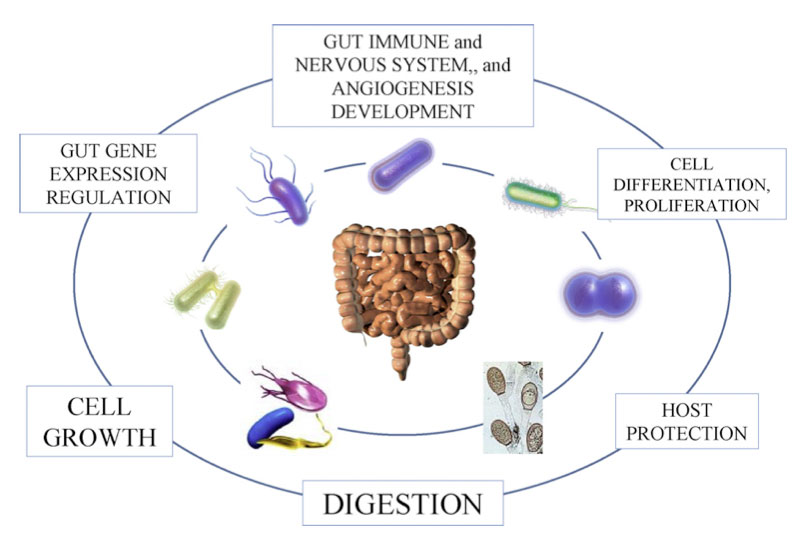
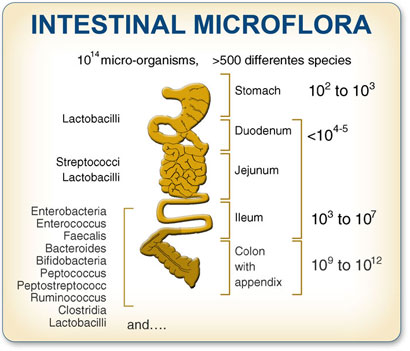
Up to 100 trillion microbes, representing more than 1,000 species, make up a motley "microbiome" that allows humans to digest much of what we eat. We lack the means to break down the food we eat into energy essential for our survival and, while bacteria could survive perfectly well without us, we would be doomed without the toil of bacteria that graze in our guts.

"The GI tract has the most abundant, diverse population of bacteria in the human body," says Dr Gill, now at the State University of New York at Buffalo. "We're entirely dependent on this microbial population for our wellbeing. A shift within this population, often leading to the absence or presence of beneficial microbes, can trigger defects in metabolism and development of diseases such as inflammatory bowel disease."

Dr Gill suspects the ecology of the human gut is at least as complex as that in soils or seas. It teems with single-celled residents that can make vitamins, such as the B vitamins that we cannot synthesise, and can break down plant sugars, such as xylan and cellobiose (similar to cellulose), which humans could not otherwise digest because we lack the necessary enzymes. Our diet would be limited if we could not: cellobiose, for instance, is a key component of plant cell walls that is found in most edible plants, such as apples and carrots.

Some bacteria in the gut break down chemicals made by plants that could cause cancer or other illnesses if they were not neutralised. Others have the capacity to scavenge hydrogen gas from the gut - a byproduct of digestion that can kill helpful bacteria - and convert it into methane. That makes the intestines a more biologically friendly place, while contributing in sometimes embarrassing and smelly incidents to greenhouse emissions. Our intestinal residents even pay us a kind of rent: bacteria in the gut make generous quantities of an enzyme that facilitates the production of butyryl coenzyme A, a fatty acid that is a favourite food of the cells that line the colon.

In short, these gutsy little helpers keep us alive. You would be nothing without the trillions of microbial minions milling around your large intestine, performing crucial physiological functions that your fancy, complicated human cells wouldn't have a clue how to do. These fabulous bugs are part of our inheritance: babies acquire their gut flora as they pass down the birth canal and take a gulp of their mother's vaginal and faecal flora. It might not be the tastiest of first meals, but it could well be one of the healthiest.

This realisation that we are super-organisms gives real meaning to the hazy idea of holistic medicine. Awareness that we depend on "good" bacteria is increasingly being exploited by manufacturers of yogurts and "probiotic" dietary supplements. Soon, doctors will test for changes in the numbers and kinds of microbes in our guts as early indicators of disease. They may prescribe live bacterial supplements to bring certain physiological measures back into normal range. And drug companies will seek compounds that mimic or amplify the actions of beneficial bacteria.

The message of the latest research is clear: we must learn to love bacteria - they are our ancestors, our tenants and our saviours.

In the rust-red Pilbara desert of Western Australia, an international team of NASA and university researchers looks at ancient rocks to see if they offer unambiguous evidence of life on Earth as long ago as 3.5 billion years. Martin van Kranendonk, and Abby Allwood, show shapes they believe could only have been formed by living organisms. Others on the scientific field trip continue to be skeptical. The ongoing debate shows contemporary research as an exciting intellectual adventure, and looking for life in the Pilbara as a physical challenge. Forget to drink often, says Kranendonk, and you could be dead in less than a day! Life, everywhere on Earth, needs water to survive.

Thursday, 16 June 2011

bacteria may help improve one of the world’s most important food crop

Scientists in Canada are showing the way to a sustainable future for farming.  At the university of Guelph, research  is continuing into the beneficial role microbes may play in a post-peak oil world.

from: this page on their website

Inoculating corn seeds with “good” bacteria may help improve one of the world’s most important food crops, according to a University of Guelph professor.

Manish Raizada, Department of Plant Agriculture, says adding useful microbes to corn might be cheaper and more sustainable than expensive chemicals to help plants use nutrients or fight diseases or pests.

Raizada recently surveyed “good” bacteria living in ancestral and modern corn grown across North America. Completed with recent PhD graduate David Johnston-Monje, this study appeared in PLoS One. The research was supported by the Ontario Ministry of Agriculture, Food and Rural Affairs, the Ontario Ministry of Research and Innovation, and the Canada Foundation for Innovation, among others.

“We have found and cultured collections of microbes that might be providing different corn with beneficial functions,” said Raizada. “We will be determining if these microbes can be useful incoculants, or biofertilizers, for corn and other cereals.”

Raizada said breeders and agrifood companies might use the results to pack useful bacteria into corn and other cereal crops.

Scientists already knew that bacteria live in corn and other plants. Like the group of microbes in your gut that help digest and absorb food, certain types of bacteria in plants and seeds appear to help the plant survive by, say, making essential nutrients available, Raizada said.

Different corn types carry varying groups of beneficial microbes, but some of the good bacteria have been lost during 9,000 years of human cultivation in North America.

The Guelph researchers set out to determine what good bacteria remain, and where they are found. They looked at 10 kinds of corn and four teosintes (forerunners of domestic corn). They chose varieties between southern Mexico, where people began to cultivate the crop thousands of years ago, and Quebec’s Gaspé region, where First Nations people domesticated a type of corn only hundreds of years ago.
“As indigenous peoples have selected and bred corn plants, they unknowingly have also selected and cultivated microbes,” said Raizada.

They found some bacteria were conserved in all corn types. Others were found only in certain kinds of corn. One microbe in a giant Mexican variety makes a chemical known to promote plant growth. Another bacterium makes a hormone that stimulates roots, which might help a corn variety grow aerial roots to support and nurture itself in swampy conditions.

Raizada plans to test the effects of those bacteria, and that of another fungi-fighting microbe, in Guelph field trials. The researchers will also study such basic questions as how these bacteria move within plants and soil.
Reintroducing microbes into corn may be a good alternative to chemicals, Raizada said. Each year, Canadian farmers already use at least $100 million worth of biofertilizers to help corn plants use nitrogen.